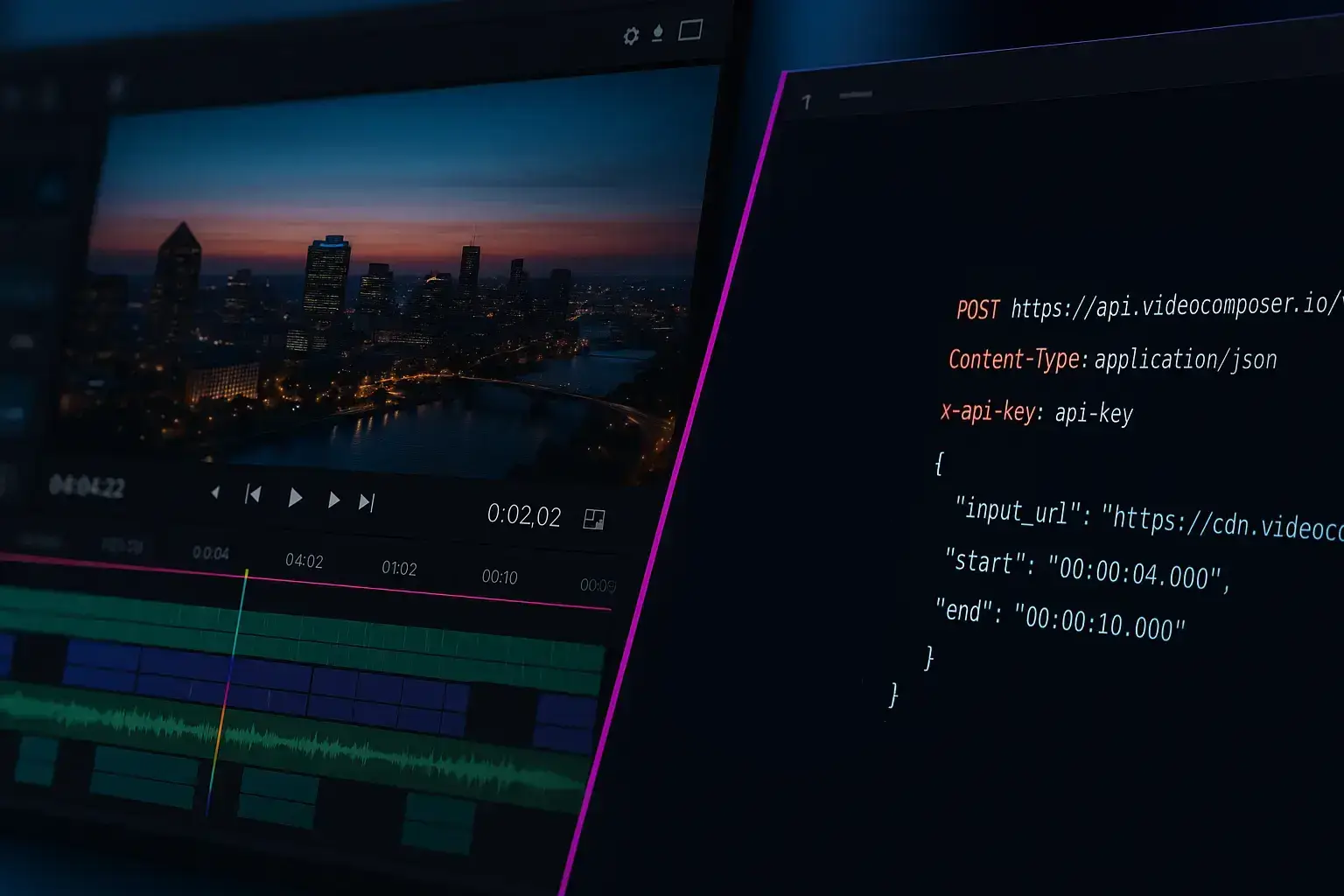
Combine multiple video clips online free, without a watermark. Add audio, burn subtitles, and apply crossfade transitions.
Use the toolTo merge videos online free, upload or paste URLs for at least two clips, arrange them in order, and submit the job. VideoComposer combines the clips into a single MP4 you can download in minutes — without a watermark, and no signup required for basic use.
You can combine videos online with optional enhancements: add background audio by providing an audio URL, burn in subtitles from an SRT or VTT file, or apply a crossfade transition between clips. All options are available in a single job submission.
To keep results consistent, inputs should share the same format and resolution. The tool produces an MP4 output, which is broadly compatible and easy to share across platforms. If your inputs are in different formats, run them through the video converter first for a smooth merge.
The merge workflow is asynchronous, so you can submit a job and return when it is finished. Developers can integrate the same flow with the API to automate merging in products or pipelines without manual uploads.
If you plan to add subtitles, provide an SRT or VTT file and the tool burns it directly into the output video. Use UTF-8 encoded subtitle files for best results and test a short clip before running large merges.
When your merge videos online free no watermark job completes, you will receive a downloadable output URL. You can save the result locally, share it with a teammate, or feed it into another tool such as the trimmer or converter. For repeatable workflows, use the API to store outputs in your own system and automate the next step.
Concatenation works best when codecs, frame rates, and resolutions match. Converting inputs to MP4 with the same dimensions produces the most reliable output.
Crossfade transitions require re-encoding, so they add processing time. Use short fades and limit the number of transitions for faster results.
Order clips intentionally and run a short test merge first. This helps confirm audio and subtitle alignment before processing a longer sequence.
If inputs have different audio lengths, the output may follow the shortest audio track. When supplying external audio, the output will match that file length, so plan your audio accordingly.
If clips come from different devices, normalize them first to avoid black bars or stretched frames. A quick conversion step usually fixes mismatched resolutions before the merge.
Upload or paste URLs for at least two video clips, arrange them in order, then submit the job. VideoComposer concatenates the clips into a single MP4 you can download — no software installation needed.
Yes. When input clips share the same format, codec, and resolution, VideoComposer merges them with minimal quality loss. For the cleanest output, convert all clips to the same MP4 format and resolution before merging.
Browser uploads are capped at 50MB per clip for anonymous/guest use and 500MB per clip when signed in. To merge larger files, use the API with direct video URLs — this has no browser upload size limit.
Yes. Provide a separate audio URL and VideoComposer will mix it into the merged output alongside the original video audio.
Yes. Provide a subtitle file URL in SRT or VTT format and the tool will burn the subtitles into the merged video output.
No. VideoComposer never adds a watermark, logo, or branding to merged output — not on the free tier, a paid plan, or the API. Anonymous sessions get 5 free jobs per day; the browser form accepts up to 3 clips per merge for guests or 10 clips once signed in, while signed-in accounts draw from a monthly credit allowance.
Yes. The API supports the same merge parameters — clip URLs, audio, subtitles, and crossfade — with asynchronous job processing and webhook notifications.
Automate video merging by submitting a list of URLs and optional audio or subtitle files. The API returns a job ID you can track until completion.
Use this approach for batch processing, internal tools, or user-generated content workflows.
If you collect clips from users, the API is ideal for stitching them into a single asset for review or publishing.
Encode or convert video to MP4, WebM, or GIF in minutes — no watermark, no install. Automate with our API.
Trim the beginning and end of a video — no watermark, clean exports every time.
Free video watermark maker — add a logo or text watermark, control placement and transparency, and export instantly.
VideoComposer merges videos online for free with no watermark on every plan, including the free tier — no signup or account required to start. Anonymous sessions get 5 free jobs per day across all VideoComposer tools; the browser form accepts up to 3 clips per merge for guests or 10 once signed in. Signing in also adds a monthly credit allowance and larger uploads.
The 5-jobs-per-day cap applies to anonymous sessions only. In the browser form, signing in raises the interface from 3 to 10 clips per merge, uploads scale from 50MB to 500MB per file, and a monthly credit allowance replaces the daily cap — 600 free credits per month on the free plan (1 credit per second of processing), with larger allowances on paid plans. Every merge — free or paid — can still add background audio, burn in subtitles, or apply a crossfade transition in a single submission.
Run the sample below, merge 2 or more clips (maximum 3 videos), or enhance a single clip with subtitles or audio.
Use a full file link like https://.../video.mp4 — YouTube, Vimeo, and Drive/Dropbox page links can't be processed. Signed CDN links can omit the extension.
Use a full file link like https://.../video.mp4 — YouTube, Vimeo, and Drive/Dropbox page links can't be processed. Signed CDN links can omit the extension.
Combine your clips, or process a single video with the selected settings